Key Takeaways
- Security drones suit large properties with blind spots but are overkill for smaller homes.
- Drone reliability is strictly limited by battery capacity, weather, and neighborhood privacy.
- Unprotected properties face up to a 300% higher risk of being burglarized.
- Technology provides visibility, but human guards deliver actual real-time threat response.
A lot of people hear “home security drone” and think of a flashy gadget, something cool, maybe a little extra, and probably not important. That reaction makes sense. But once you look at how security drones fit into real home protection, the picture gets more interesting. In short, they can be worth it, but not for every house.
The real question is whether they solve a problem you actually have, or just add another device to charge, update, and worry about. This guide breaks down where drone security helps, where it falls short, and when a simpler setup may be the smarter move.
Why Home Security Drones Are Getting Attention
The appeal is easy to understand. A fixed camera watches one angle. A drone can move. That single difference changes the whole conversation.
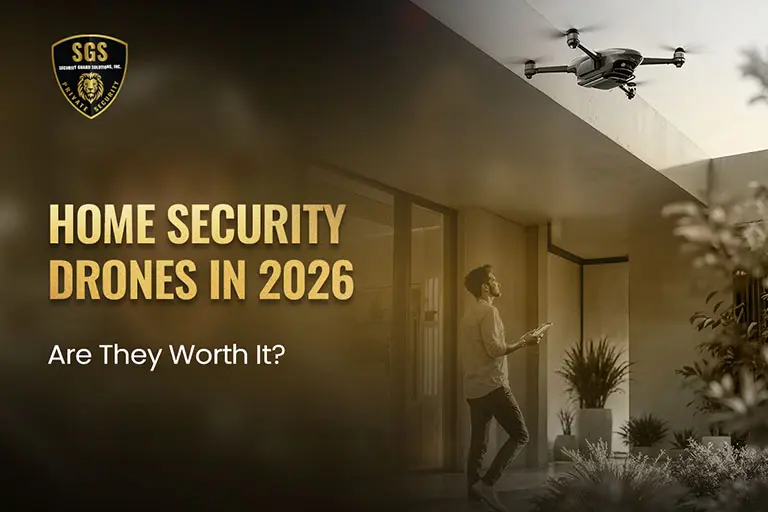
For homes with wide yards, side entrances, long driveways, or spots that do not get much light, surveillance drones can cover ground faster than a wall-mounted camera ever could. They can check a back gate, circle a property, or move toward an alert point without anyone running outside in the dark.
That said, the hype can get ahead of the reality. A drone security system still depends on battery life, signal strength, weather, and how well the homeowner sets it up. So yes, the idea is strong. The execution matters more.
Are Security Drones Actually Worth It for Homeowners?
Here is the honest answer. Sometimes yes, sometimes no.
If you live on a larger property, or your home has blind spots that make camera coverage awkward, security drones can be a smart add-on. They are also useful when you want a faster look at what is happening outside instead of waiting for a person to step out and check.
On the other hand, if your home is small, your perimeter is simple, and your current cameras already cover the key spots, a drone may feel like overkill. Well, here is the thing, not every security problem needs a flying answer.
So when people ask whether a home security drone is worth the money, the better question is, what gap is it filling?
What Security Drones Do Well
This is where the idea starts to make sense. A drone can do a few things especially well:
- Check outdoor space fast after a motion alert.
- Reach corners, gates, and side yards that are hard to see.
- Give a moving view instead of a single fixed angle.
- Help track activity across a wider property.
That kind of coverage matters when you are trying to get a quick read on what is happening outside. A porch camera is useful. A drone can see more of the story.
We also need to be fair here. Drone surveillance is not about replacing every camera you own. It is more about adding movement and reach. For people who feel boxed in by fixed angles, that matters a lot.
Where The Limits Show Up
This is the part that people sometimes skip, then regret later.
A drone needs power. It needs maintenance. It needs a clean landing spot, a stable connection, and some level of planning. It is also not the best choice in heavy wind, bad weather, or neighborhoods where privacy concerns run high.
That last point is a big one. A drone may feel useful to the homeowner, but the people around it may see it very differently. So even if the tech is impressive, the social side still matters.
A drone security system can also struggle if the property layout is too tight, or if the drone has to travel far just to cover a basic area. At that point, a strong camera setup and a good alarm may do a better job with less fuss.
Security Drones Versus Cameras, Alarms, And Patrols
This is where the comparison gets practical.
Fixed cameras stay reliable. Alarms react fast. Lights help deter movement. A drone adds mobility and a wider outdoor view. Each tool handles a different part of home security.
Multiple security studies found that homes without security systems are up to 300% more likely to be burglarized than homes with protection in place. In many homes, the strongest setup comes from combining them together.
| Security Option | Best Use | Limitation |
|---|---|---|
| Fixed Cameras | Continuous monitoring | Limited viewing angles |
| Alarm Systems | Instant alerts | No visual tracking |
| Security Drones | Outdoor scans and movement checks | Battery and weather limits |
| Motion Lights | Deterring trespassers | No recording ability |
| Mobile Patrol Services | Active on-site response | Higher monthly cost |
What To Think About Before Buying One
Before buying a home security drone, slow down for a minute and ask a few plain questions.
- How big is the property?
- How much outdoor space needs coverage?
- Do you already have enough camera angles?
- Will you actually use the drone often, or just once in a while?
- What happens when the battery runs low?
These questions sound basic, but they save money. A lot of security purchases happen in that “this looks smart” moment. Then the device arrives, and reality shows up.
Also, check local rules, app control, storage options, and how easy it is to get live views when something triggers motion. If the setup feels clumsy, people usually stop using it. That is the quiet truth with a lot of tech.
When Human Backup Makes More Sense
There are times when a person still does the job better.
If a property has regular foot traffic, repeated access issues, or a higher chance of trespassing, human patrols can be more dependable than another gadget. A drone can look. A trained guard can observe, respond, and make judgment calls.
That matters because security is not only about seeing movement. It is also about knowing what to do next.
Human security support often makes more sense when:
- Visitors and deliveries come in frequently
- The property has multiple entry points
- Trespassing or vandalism happens repeatedly
- Someone needs to respond in real time
- Outdoor areas are too large for fixed cameras alone
A lot of homeowners still prefer having a real person involved when the situation feels uncertain. Technology can help spot activity, but people are usually the ones who decide how serious it actually is.
Why This Matters for Real-world Home Protection
This is where the conversation becomes less about gadgets and more about results.
A drone can help you see more. A person can help you respond faster. Sometimes that difference matters more than the technology itself.
For many homeowners, the strongest setup combines smart tools with active protection. That extra layer can make a big difference when a home security drone alone is not enough.
Where Security Guard Solutions Fits In
If the problem is broader than one device can handle, that is where we come in.
At Security Guards Solution, we provide security services that support real properties, not just nice-looking checklists. We work with homes, businesses, and larger sites that need attention beyond a camera feed. For clients who need moving coverage, our mobile patrol security is a practical fit. For places that need a steady on-site presence, our standing guard security and unarmed security options give them another layer to lean on.
We have also built our coverage around California and Texas, because security needs do not stop at a city limit. If a reader is comparing security drones with a more complete protection plan, this is the kind of decision point that matters.
Conclusion
So, are home security drones in 2026 worth it? Sometimes, yes. They make the most sense for larger homes, tricky layouts, and properties where moving outdoor coverage adds real value. But they are not a magic fix. They work best when paired with cameras, alarms, and, in some cases, human patrols.
If the goal is better protection rather than simply adding more technology, it helps to start with the actual security gaps first. From there, the right setup becomes much easier to figure out. In many cases, the best results come from combining practical tools, smart monitoring, and reliable support that fits the property’s real needs.
Frequently Asked Questions
Are home security drones worth it?
Only for large properties. They are great for expansive yards and blind spots, but standard cameras are better and cheaper for smaller homes.
What are their main limitations?
Battery, weather, and privacy. Drones require constant charging, fail in high winds or rain, and can upset neighbors in tight spaces.
How much do security systems reduce burglary risk?
Unprotected homes are up to 300% more likely to be burglarized. Layering tech or patrols provides the strongest defense.
When is a security guard better than a drone?
When you need an active response. Drones only record, but human guards can intervene, make judgment calls, and manage frequent visitors.
What is the best setup for large properties?
A hybrid mix. Pair smart tech with physical backup. Security Guards Solution provides mobile patrols and standing guards across California and Texas to close the gaps drones miss.