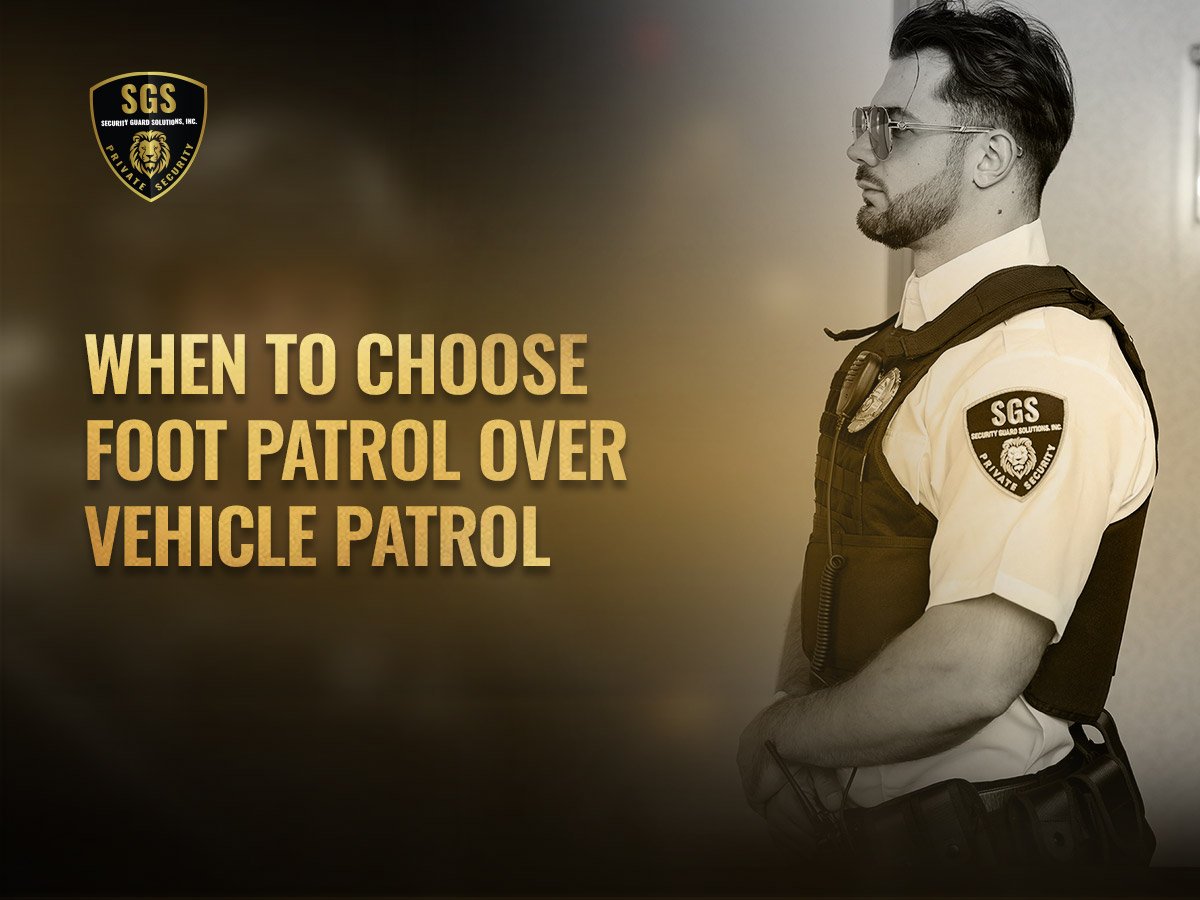
Choose foot patrol when security risks are concentrated around doors, stairwells, courtyards, garages, or crowds. Choose vehicle patrol when distance and perimeter coverage are the bigger challenges, such as at business parks or across multiple sites. In the foot patrol vs vehicle patrol decision, a hybrid strategy can cover both close-range risks and large areas.
Nearly four decades later, a randomized Philadelphia study found a 23 percent relative reduction in reported violent crime in targeted hot spots receiving foot patrol.
The contrast between those findings helps explain why the foot patrol vs vehicle patrol decision depends on where patrol is concentrated and what it is expected to accomplish.
This guide covers where walking the grounds earns its cost and how to combine both on a California property.
Key Takeaways
- Foot patrol suits compact, crowded, multi-level, or high-contact sites.
- Vehicle patrol security suits large perimeters and several sites in one shift.
- Spending about 11 to 15 minutes at a hot spot can create longer residual deterrence than a brief drive-through.
- Verify any California provider’s license and guard registrations before you sign.
Foot Patrol vs Vehicle Patrol: What are the actual differences?
Foot patrol places a guard on a defined route on foot, whereas vehicle patrol moves a guard between points in a vehicle. Each method solves a different coverage problem. One offers closer observation, and the other covers more ground.
| Factor | Foot Patrol | Vehicle Patrol |
|---|---|---|
| Coverage area | Small and concentrated | Large and flexible |
| Visibility | Close and personal | Broad but brief |
| Public interaction | More frequent | Usually more limited |
| Detail detection | High | Moderate |
| Movement across a large site | Limited by walking speed | Faster across long distances |
| Best fit | Retail centers, apartment communities, campuses, parking structures | Industrial yards, construction sites, business parks, multi-site routes |
What Are the Main Security Patrol Types?
Security patrol types can take several forms. Four common approaches are as follows:
1. Foot patrol: Guards walk set routes and check doors, stairwells, and common areas.
2. Vehicle patrol: Guards drive marked or unmarked vehicles between checkpoints.
3. Bicycle patrol: Guards gain near-foot contact with much greater range.
4. Hybrid patrol: Guards drive to a zone and then walk it.
Bicycle and hybrid options can bridge the gap between coverage and close observation. These types of security patrols give guards more range without relying entirely on a vehicle.
Why Foot Patrol Security Works in Busy Environments
Foot patrol security can make a difference when proximity matters. A guard moving through the area can interact with people and spot conditions that never trigger an alarm.
One of the clearest examples comes from Philadelphia. Researchers placed foot officers in 60 violent crime hot spots. The study reported a drop in violent crime in those targeted areas. The reduction was observed in the targeted violent-crime hot spots, where baseline violence was high.
How Does Foot Patrol Improve Visibility and Trust?
Visible and approachable guards can influence how people perceive safety in a place. That sense of safety carries commercial value.
A study of 352 adults in Sweden measured perceived safety in scenes showing different types of uniformed presence. In relatively unsafe scenes, participants rated perceived safety at 1.84 without uniformed presence. Security officers raised it to 3.89. A police vehicle raised it only to 3.36.
What Can a Guard on Foot Detect That a Car Misses?
A car can pass a propped fire door in seconds. A guard on foot can stop, inspect it, and report or address the problem. Walking routes reveal the small signs that precede bigger incidents, such as:
- Damaged locks, fences, or lighting.
- Loitering in stairwells or blind corners.
- Unusual odors, sounds, or smoke.
- Unauthorized access through side entrances.
The other advantage is information from people. Tenants and shop staff tell a familiar guard things they would never report to a passing car, such as “the side gate hasn’t latched all week.” Property managers have good reason to care about these small failures because minor maintenance and access issues can create larger security problems.
When Does Vehicle Patrol Security Make More Sense?
Vehicle patrol security makes more sense when distance is the main challenge. A guard on foot cannot cover forty acres or six separate sites in a single shift. A car, however, can.
Vehicles also suit properties where perimeters matter more than interiors. Examples include storage yards, construction staging areas, and large business parks. A marked vehicle can make the patrol presence visible from a distance and allow the guard to move quickly between checkpoints.
Driving a route at random also offers less value than a patrol tied to defined checkpoints, observations, and reporting.
What Type of Patrol Does Your Property Need?
Choose foot patrol when the risks remain close to the ground and close to people. When the risks involve doors, corridors, crowds, or interior spaces, a vehicle may leave more to observe on foot.
Foot patrol is usually the stronger choice in the following conditions:
- Pedestrian traffic is heavy throughout the day or evening.
- The property has multiple levels, courtyards, or parking structures.
- Guests, tenants, or students expect visible and approachable security.
- Past incidents involve trespassing, theft, or tampering around entry points.
- Events draw crowds that need active guidance.
Before choosing, walk around your property at 10 p.m. with a notepad. List every spot an automobile could not see or reach. That list can make the patrol gap much easier to see.
| Property Type | Potentially Suitable Approach | Reason |
|---|---|---|
| Outdoor shopping center | Foot patrol | Heavy foot traffic and customer contact |
| Apartment complex with courtyards | Foot patrol | Interior areas unreachable by car |
| College or corporate campus | Foot, bicycle, or hybrid patrol | Mixed pedestrian zones, buildings, and larger grounds |
| Multi-level parking structures | Foot patrol | Blind corners and stairwells |
| Industrial yard | Vehicle patrol | Large perimeter and open grounds |
| Several scattered sites | Vehicle patrol | Travel between locations |
Is Foot Patrol Security a Good Fit for Your Property?
Foot patrol security in California can suit dense commercial and residential settings where guards need to move through shared spaces on foot. Downtown corridors, mixed-use developments, apartment communities, and other pedestrian-heavy properties may benefit from that closer presence.
However, California site planning also needs to account for working conditions, particularly during hotter periods in inland areas.
Once you’ve identified the patrol approach that fits the property, the next step is choosing a qualified provider. For that, licensing should be the first check. The Bureau of Security and Investigative Services (BSIS) regulates California’s private security industry. Security guards are employed by licensed Private Patrol Operators or private security employers.
Before signing, do four things:
- Verify that each guard has a current BSIS security guard registration.
- Ask about training. BSIS requires Power to Arrest training before security guard registration and 32 hours of security officer skills training within the first six months of registration.
- Ask how patrols are logged and reported.
A licensed provider can then build the patrol plan from a documented risk assessment.
What Does a Hybrid Patrol Look Like?
A hybrid plan assigns each method to the part of the property it can cover most effectively. Vehicles cover larger perimeters and move between zones. Foot patrols handle entrances, interiors, and high-contact areas.
A hybrid approach can also be informed by research on how long patrol officers need to remain at a problem location. In a study of Minneapolis crime hot spots, criminologist Christopher Koper found that patrol stops of about 10 minutes were associated with longer periods without disorder than brief drive-throughs.
A practical hybrid schedule often looks like this:
- Vehicle patrol for perimeter checks and fast response.
- Foot patrol during peak traffic and at after-hours entry points, with roughly 10 to 15 minutes spent at known trouble spots when the site assessment supports it.
- Change timing and route order, so predictable patrol patterns are harder to anticipate.
Final Remarks
Foot patrol vs vehicle patrol is a decision about fit. Compact, crowded, and detail-heavy properties may benefit from guards on foot. Large or scattered sites can use vehicles to cover greater distances. Many properties can combine the two approaches.
Security Guard Solutions can assess your site and help determine an effective patrol strategy. Contact the team to schedule a consultation regarding patrol security in California.
FAQs About Foot Patrol vs Vehicle Patrol
What is the main difference between foot patrol vs vehicle patrol?
Ask which gap matters more on your property: missing a small warning sign or taking longer to reach a distant area. Foot patrol addresses the first gap more directly. Vehicle patrol helps cover the second. Your incident history can show which problem deserves more attention.
Is foot patrol more effective than vehicle patrol?
It depends on the setting and the risk being addressed. Research supports that targeted police foot patrol reduced reported violent crime in selected high-crime hot spots, with the effect disappearing after officers were removed. That finding does not establish that private security foot patrol is more effective than vehicle patrol across all property types.
How often should a security guard patrol on foot?
Let your incident logs help set the schedule. Start with more frequent rounds in the hours and zones where reports cluster, then adjust as patterns change. Review the logs regularly and shift patrol time toward areas where problems persist.
Does foot patrol cost more than vehicle patrol?
Foot patrol can cost more per area covered because a guard on foot generally covers less ground per hour. The better comparison is the cost of coverage relative to the risks and areas the patrol needs to address. A smaller property with concentrated risks may still justify more time on foot.
Can a property use both security patrol types?
Yes. A property can use vehicle patrol for distance and foot patrol for areas that need closer observation. The weak point is the handoff between the two. A shared log, radio contact, and a clear rule for who responds to what keep a hybrid plan from leaving gaps.