
Key Takeaways
- Smart locks automate access tracking but lack human judgment.
- Live guards interpret active risks and stop real-time threats.
- Commercial sites maximize safety by blending locks with guards.
- Reliable security requires balancing technology with human presence.
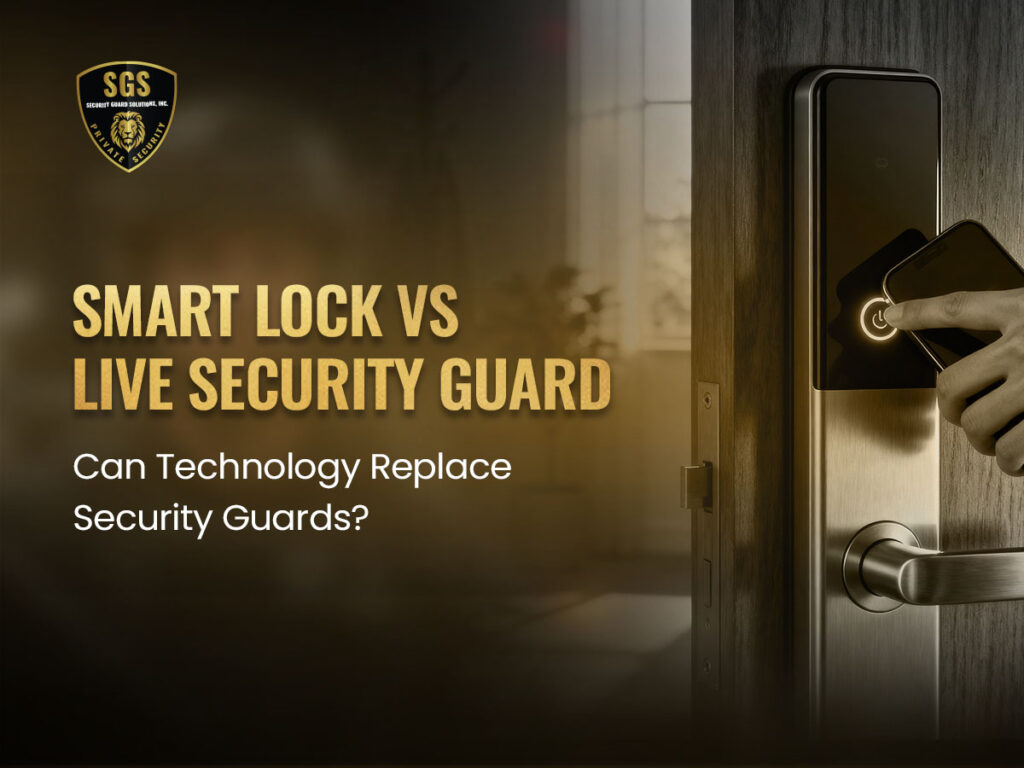
A lot of people like the idea of a smart lock because it feels neat, simple, and modern. One tap, one code, one app, and the door opens. But real security usually gets more complicated than that. Smart locks vs live security guards? It is not just a tech question; it is a question about what you are trying to protect, and what kind of risk you are dealing with. In most cases, technology helps, but it does not fully replace a trained person who can see, judge, and act. That is where the real discussion starts.
What Smart Locks Actually Do Well
Smart locks are useful because they make access easier to manage. In fact, the global smart locks market stood at USD 3.1 billion in 2025 and is expected to rise to USD 3.5 billion in 2026. You can assign codes, track entry, and remove access without changing a lock every time someone leaves. For homes and small offices, that is a real convenience. It also helps with smart access control, especially when a property has several users, and you need a cleaner way to handle keys.
Still, smart locks vs security guards is not a fair one-to-one fight. A lock can control the door. It cannot watch the parking lot, notice a strange pattern, or step in when a situation starts to shift. That is why commercial smart locks work best as part of a bigger setup, not as the whole setup. The value is clear, but the limits are just as clear.
What Live Security Guards Bring That Technology Cannot
A guard does more than stand at a door. A guard notices behavior, asks questions, checks details, and responds in real time. That human layer matters when the issue is not just access, but risk. This is where the live security guard benefits become easy to see. People often feel safer when a trained officer is present, but more importantly, a guard can act when a system only sends a notification.
That is the heart of technology vs human security. Technology can alert you. A person can interpret what the alert means and what should happen next. With automated security vs guards, the strongest answer is usually not choosing one side too quickly. It is understood that a device reacts to a rule, while a guard reacts to what is happening right now. That difference sounds small until something goes wrong.
Smart Locks vs Security Guards in a Business Setting
For a business, the question gets sharper. Smart locks for businesses can help with staff entry, after-hours access, and simple entry tracking. They are practical, and they reduce the mess that comes with lost keys and shared access. However, they do not stop every problem. A door can stay locked, and a site can still face tailgating, theft, damage, or a tense visitor issue.
This is where smart locks vs live security guards becomes a planning question, not a product question. If your business has steady traffic, after-hours activity, sensitive equipment, or a public-facing space, a guard can fill gaps that software cannot. In that sense, security technology comparison is useful only when it stays honest. The best system is the one that matches the site, not the one that sounds most modern. That point matters more than people admit.
Smart Home Security vs Guards: What Makes Sense at Home?
At home, the answer can feel more personal. Smart home security vs guards often comes down to routine, neighborhood risk, and how much control you want over who enters. A smart lock can be enough for a typical household that wants easy access and simple management. It is convenient, and that convenience matters in daily life.
But some homes need more than that. Larger properties, homes with frequent visitors, or places with higher risk may need a person on site, even for limited hours. The key is not to assume that a lock solves every problem. It usually solves one part of the problem, and that is all.
Once that is clear, the next question becomes a practical one: where does physical presence still matter most? That leads straight into the real limits of both systems.
Digital Security vs Physical Security: Where Each One Falls Short
The phrase digital security vs physical security sounds technical, but the issue is simple. Digital tools can fail because of battery issues, app problems, poor setup, or network trouble. Physical protection can fail when staffing is thin, patrols are irregular, or no one is present when something changes quickly.
That is why smart locks vs security guards is better treated like a layered security conversation. You may not need a guard every hour of the day. On the other hand, you may need more than a lock if the property faces theft, trespass, or repeated access issues. A door system guards the entry point. A person guards the situation.
Those are not the same job, and that distinction does a lot of the heavy lifting here. The balance usually depends on the site, the risk, and the hours that matter most.
Why the Best Answer Is Often a Mix
For many properties, the strongest setup combines both sides. Smart locks vs live security guards does not have to end with a winner. It can end with a layered plan. A smart lock manages entry. A guard handles observation, response, and judgment. Put together, they cover more ground than either one can cover alone.
This is also where the rest of the security plan matters. Smart access control can keep entry organized. A guard can keep the whole site under watch. For a warehouse, apartment building, office, or retail space, that mix often makes more sense than a single tool. It is not dramatic. It is just practical.
And honestly, that is what good security usually looks like, nothing flashy, just the right pieces in the right places.
How Security Guard Solutions Help Solve the Problem
At Security Guard Solutions, we have seen that security rarely comes down to choosing between technology and people. Most properties need a mix that fits their day-to-day risks. Some businesses benefit from smart access control paired with unarmed guards for visibility and visitor management. Others need mobile patrols, fire watch coverage, or armed security when the environment carries a higher risk.
As a premier security guard company, we provide security services for office buildings, apartment communities, retail properties, construction sites, and other commercial spaces across California and Texas. Over time, one thing has stayed consistent: technology helps with access and monitoring, but trained professionals still play a major role when quick judgment, presence, and response matter most.
Conclusion
So, can technology replace security guards? Not fully. Smart locks vs live security guards is really about where control ends, and real-world response begins. Smart systems do a good job with access, records, and convenience. Guards do a better job with awareness, judgment, and response when something feels off. That is why the smartest setup is often a mix, not a choice made in a hurry.
If you are weighing smart locks vs security guards, the best place to start is the property itself. A quiet office after business hours will have very different security needs than a busy apartment complex or active construction site. That is why the answer is rarely as simple as choosing technology over people. In many cases, the most reliable setup comes from understanding where automation helps and where human presence still makes a real difference.
Frequently Asked Questions
Can smart locks fully replace live security guards?
No, smart locks cannot replace live guards. Locks automate digital access control, but they lack human judgment. A device only enforces a rule, while a guard actively stops threats.
What are the main benefits of a live security guard vs automated security?
The main benefit of a live guard is immediate physical intervention. Automated systems only send alerts. A guard interprets situations in real time, manages conflicts, and stops risks instantly.
How do commercial smart locks and security guards work together for business security?
They combine automated efficiency with physical protection. Smart locks handle daily employee entry and access logging, while live guards patrol the site, prevent tailgating, and handle emergencies.
What are the limitations of relying only on digital physical security?
What are the limitations of relying only on digital physical security?
The limits are technical vulnerability and zero response capability. Systems fail during power or network outages. If a lock is bypassed, the digital tool only records the incident rather than stopping it.
Should a business choose automated access control or hire a security service?
The best setup combines automated access with professional security services. Quiet sites can rely on automated access control alone, but high-traffic commercial spaces require live guards for real-time response.