
Key Takeaways
- Hourly rates fluctuate based on whether unarmed or armed protection is chosen.
- Mobile patrols cost less than keeping stationary guards at fixed posts.
- Total costs depend on warehouse size, risks, and shift lengths.
- Watch out for hidden fees like overtime and supervisor checks.
AI Overview
This 2026 warehouse security guide breaks down costs, ranging from $20–$40/hour for unarmed guards to $35-$70/hour for armed personnel. Pricing depends on facility size, risk, and hidden operational fees.
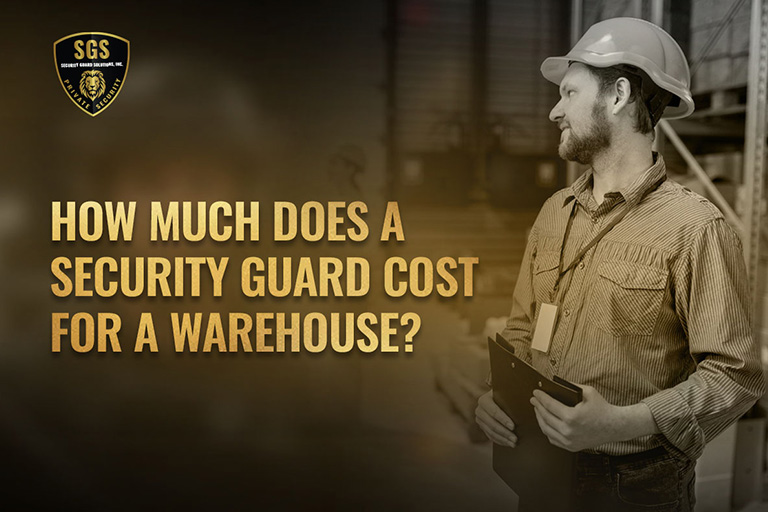
One break-in, one case of stolen inventory, or one late-night security incident can cost far more than hiring a professional guard. That is why many warehouse owners ask the same question, how much does a security guard cost for a warehouse in 2026?
The answer typically ranges from $20 to $70 per hour, depending on your facility, risk level, and the type of coverage you need. In this guide, we break down what affects warehouse security guard costs and how to choose warehouse security services that fit your budget.
What Drives Warehouse Security Guard Cost?
- Site size and number of access points.
- Day shift, night shift, or 24-hour coverage.
- Risk level, including theft history and neighborhood conditions.
- Whether you need a guard on-site or rolling patrols.
- Reporting, supervision, and post orders.
- Armed security versus unarmed security.
- Special tasks like fire watch security, or gate control.
What Does 2026 Pricing Usually Look Like?
Here is the part most managers want first, the practical range. Current agency pricing in 2026 commonly places unarmed guards around $20 to $40 per hour, while armed guards often land around $35 to $70 per hour. In California-style market pricing, unarmed posts are often listed at $25 to $45 per hour, and armed posts at $35 to $65+ per hour. Mobile patrol is often cheaper overall than keeping one guard parked at a post all night.
Quick Pricing Table
| Service type | Common 2026 range | Best fit |
|---|---|---|
| Unarmed guard | $20 to $40 per hour | Basic warehouse access control |
| Armed guard | $35 to $70 per hour | Higher-risk sites or valuable stock |
| Mobile patrol | Often lower than full-time post coverage | Large yards, outer perimeters, overnight checks |
| Fire watch security | Usually quoted separately | Sites with fire risk or code-related coverage needs |
| Standing guard coverage | Often priced by shift length | Fixed entrances, docks, and controlled entry points |
If you are comparing quotes, the real number usually sits inside the gap between “basic presence” and “active responsibility.” That is where warehouse security services start to feel different from a plain hourly guard line item.
Which Setup Makes Sense for Your Warehouse?
The right setup depends on how your property works in real life, not how it looks on paper. A quiet storage site may only need a single post during vulnerable hours. A busier facility may need a mix of coverage types.
Service Fit Table
| Warehouse situation | Better fit | Why it usually works |
|---|---|---|
| Small warehouse with one entrance | Unarmed security | Keeps access controlled without overpaying |
| Large lot or wide perimeter | Mobile patrol | Covers more ground at a lower total cost |
| Loading dock with steady traffic | Standing guards | Helps with entry control and visitor flow |
| High-value inventory or repeated incidents | Armed security | Adds stronger deterrence and response |
| Fire-risk site or code-driven coverage | Fire watch security | Covers temporary hazards and reporting needs |
This is also where the distribution center security cost tends to rise. Bigger footprint, more movement, and more pressure on staff all add up. In other words, the same guard can do a good job, but the job itself is simply bigger.
That is why security guard rates for warehouses often look lower than the final invoice once the plan includes multiple posts or long overnight hours.
A lot of readers also ask about the benefits of mobile patrol security. The simple answer is that it helps when you need visibility across a larger area without paying for someone to stand still all night. That is especially useful on yards, fence lines, and dock perimeters.
The same thinking often shows up in the reasons to hire security guards for your construction site, which is really about watching open spaces, deterring theft, and catching problems early.
What Costs Get Missed in the First Quote?
This is where a cheap quote can stop being cheap.
Look closely at these items:
- Overtime and holiday pay.
- Supervisor checks.
- Incident reports and daily logs.
- Post-training for your site.
- Access control tasks.
- Alarm response.
- Replacement coverage when a guard calls out.
- Equipment or uniform fees, if they are separate.
Warehouse loss prevention cost is not only about a person in a uniform. It is also about the systems behind that person.
A solid quote should tell you how the company handles reporting, how fast it replaces missed shifts, and whether the guard actually knows your site rules. Standing guards, for example, usually require tighter supervision than a quick drive-by check.
How Security Guard Solutions Fits into the Picture
At this point, the question is less about whether you need security and more about how to set it up without wasting money. That is where a good security guard company matters.
We provide 24/7 security services across California and Texas. We also offer mobile patrol security, standing guard services, fire watch security, and construction site security, which makes it easier to match the service to the actual risk.
That matters because warehouse protection is rarely just one thing. It is usually a mix of access control, patrols, and steady reporting.
For many sites, hiring a licensed security guard company is the smartest decision because it reduces the guesswork around training, supervision, and response. That is especially true when you need commercial security that supports both the property and the people working inside it.
How Should You Compare Quotes Without Getting Burned?
Before you approve a service plan, ask a few plain questions:
- What is included in the hourly rate?
- Is the guard unarmed security or armed security?
- Do you charge extra for standing guards or mobile patrol?
- How do you handle call-outs and shift replacement?
- Will the quote include reports, logs, and supervision?
- Do you already cover warehouse or distribution work?
That last question matters more than people think. A guard company that understands loading docks, gate traffic, and overnight inventory movement usually gives a cleaner plan from the start.
And yes, that can save money later. Not always, but often enough to matter.
Conclusion
So, how much does a security guard cost for a warehouse in 2026? Most sites will see unarmed coverage in the $20 to $40 per hour range, while armed coverage often sits higher, around $35 to $70 per hour.
From there, the final number depends on patrol needs, site size, fire risk, and how much reporting or supervision you want built into the service. That is why the warehouse security guard cost should be tied to your actual layout, not just a generic rate card.
If you are comparing warehouse security guard pricing right now, start with the basics: access points, shifts, risk level, and whether you need mobile patrol, standing guards, or a full coverage mix.
Then match that against a security guard company that knows warehouse work and can explain the numbers clearly. We provide that kind of structure because, frankly, vague pricing helps no one. And for a warehouse, vague security is usually where the trouble starts.
FAQs
What is the average hourly cost of a warehouse security guard in 2026?
In 2026, warehouse security guards typically cost between $20 and $70 per hour. The final rate depends heavily on your facility’s specific risk level, layout, and the required coverage type.
What is the price difference between armed and unarmed warehouse guards?
Unarmed warehouse guards cost $20 to $40 hourly, while armed guards range from $35 to $70 per hour. Armed security commands higher rates due to increased risk and advanced capability.
How does mobile patrol pricing compare to stationary standing guards?
Mobile patrols are generally more cost-effective than full-time standing guards. They offer a cheaper alternative for checking large yards, outer perimeters, and fence lines without paying for constant stationary presence.
What hidden fees are often missed in initial warehouse security quotes?
Initial quotes often omit overtime, holiday pay, supervisor checks, and incident reporting. Ensure your contract explicitly covers post-training, replacement guards for call-outs, and all separate equipment or uniform fees.
Why do distribution centers face higher security costs than small warehouses?
Distribution centers have larger footprints, multiple access points, and continuous traffic. This increased operational scale and movement require complex security plans, multiple posts, and extensive supervision, driving up final invoices.